Monday, March 31, 2008

Carrot Hiatus


There haven't been many local carrots around the past few weeks. That's disconcerting, because all through the bleak winter they've been such a consistent staple. Still, their absence lately is a sign that many good things are on the way, like strawberries, and asparagus, and snap peas.

Sunday, March 30, 2008

Vegfest this Weekend

I spent this weekend at the 8th annual Vegfest. I've been doing the Vegfest since the very beginning, and I love it and I hate it.

I love the fact that this organization is able to organize 700 volunteers in order to pull off the largest vegetarian festival in North America. It's life affirming. I do believe that, as a species, we need to learn to eat less meat, and this organization certainly does their share towards helping to make that happen.

I hate the fact that it turns into such a feeding frenzy. That's an environment that doesn't bring out the best in people. And I hate being lectured about the purity of my ingredients when I spend most of my waking hours thinking about the best way to eat. I also wish there was more fresh food, and less processed stuff.

For all that, I'll be happy to participate next year, and the year after...

Saturday, March 29, 2008

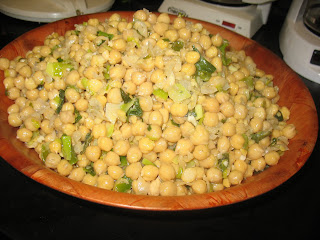
Chickpeas with Leeks and Herbs


This weekend is the annual Vegfest at the Seattle Center. Each year I cater a dinner the night before the event starts for the principal people involved. It's one of my favorite meals that I prepare all year because I'm cooking for cookbook authors and other people who are heavily involved in the food world. Here's a recipe I came up with for this year's dinner.

2 tablespoons olive oil

1 leek, cut in half lengthwise, cleaned well, and sliced

2 cloves garlic, minced

2 tablespoons chopped fresh chives

1 tablespoon chopped fresh tarragon

1/2 teaspoon salt

black pepper to taste

2 cups chickpeas, cooked or canned

1 tablespoon champagne vinegar

1. Heat the olive oil in a small saucepan, then add the leek and garlic. Cook on medium low heat for about five minutes, until the leek is soft. Turn off the heat, then add the chives, tarragon, salt and pepper.

3. Combine this mixture with the chickpeas and vinegar. Serve at room temperature.

Friday, March 28, 2008

Local Ice


This is ice from Portland, in the freezer at the wholesale foodservice grocery in Seattle. A while back the price increased, and the employees were apologizing, saying that they had to charge more to cover the gas.

I asked why they didn't buy ice from the ice maker in Seattle, and they answered that their customers liked the shape of the Portland ice better.

Then one day I went in there and found both Seattle ice and Portland ice for the same price. I asked why they were charging more for the Seattle ice when the price increase was supposed to pay for the gas to ship the ice from Portland. They just looked confused.

These days, whenever I can, I just go to the ice maker in Ballard, and buy my ice directly from them.

Thursday, March 27, 2008

Cheap Eating Without Discount Stores

Here are some helpful hints, in response to an article in yesterday's New York Times about gourmet cooking with dollar store foods. There are plenty of ways to save money on food without buying lots of processed garbage.


1. Buy bulk foods whenever possible. They're much cheaper than the packaged stuff.


2. Eat less meat and dairy. Learn to use these foods as components, rather than as the bulk of a meal. That's how most people have eaten for most of history.


3. Eat fruits and vegetables in season. In the spring you can get artichokes for less than a dollar. In the winter they're more like three dollars.


4. Pay attention to the price of each item you put in your shopping cart. If pecans are $9.50 a pound, pay attention and buy just what you need, instead of filling the bag because you're not paying attention.


5. Buy ethnic foods at ethnic stores. Taro root at Viet Wah, in the International District, costs less than a dollar a pound, but it's $3.99 a pound at Whole Foods. A lot of the other stuff at Whole Foods is competitive price-wise, but the ethnic specialty stuff is off the charts.


6. Learn what things should cost. If you're aware that conventional parsley is usually around $1/bunch, and organic parsley usually costs about $1.50, you'll know not to buy it when someone's charging $2.50.


Note that the first three suggestions are not only ways to save money, but also ways to eat more sustainably. And yet we tend to think of sustainable food as a more expensive option. Now there's some food for thought.

Wednesday, March 26, 2008

A Trip to the Grocery Outlet


The New York Times had an article in today's food section by a chef who tried to fix some decent meals using items from a discount grocery store.

I thought I'd write something in response about how you can save all kinds of money on groceries without shopping at discount stores. But first I thought I should take a closer look at the discount store in my neighborhood, in case it defied my preconceptions.

I generally stay away from these stores because I'm turned off by all the cheap, processed foods. But the Madrona Farmers' Market, where I vend, is held in the parking lot of a Grocery Outlet. They're great hosts, and I can usually pick up items there that I've forgotten to bring, like soap and paper towels.

Today I checked out the store on 130th and Aurora. As I expected, I found long aisles of canned meats and vegetables, and boxes of convenience foods. But I was actually impressed with the cheese section, which included ricotta salata as well as several varieties of flavored havarti.

I was disturbed by an observation I made on my way out the door. The ice was priced at 99 cents, and the sign said that was a $2 savings over the price of $2.99 that regular grocery stores charge. I buy ice regularly, and I rarely see it for more than $1.29. Even Whole Foods--Whole Foods!--sells a bag of ice for a dollar. If discount store prices are so low, why do they have to lie about what the competition is charging?

Tuesday, March 25, 2008

March Is National Frozen Food Month


I rolled my eyes the first time I saw this sign: just another trade organization making another desperate grab for our attention.

But then I got to thinking about frozen foods, and I started feeling like maybe they are worth celebrating.

Despite the ubiquity of TV dinners, frozen foods are far superior to canned foods in flavor and also in nutritional content. All in all, freezing may be the best way to preserve food, although drying certainly has its benefits, and even pickling can make a tasty product.

Clarence Birdseye invented the frozen food process in 1923. He'd observed people in northern climates storing food in ice, and was looking for a way to preserve seasonal produce. As an aspiring locavore, I can certainly appreciate the sentiment.